 Garnica & Co
Blog
Colombian Spanish vs Textbook Spanish: Why Real Speech Feels Different
You finished the chapter. You know the dialogue. Then someone from Colombia says a normal sentence — and it feels like a different language.
That gap is not a failure. It is the difference between textbook Spanish and Colombian Spanish as people actually speak it. Closing the gap needs both grammar and real input — ideally from a native teacher who plans lessons on purpose.
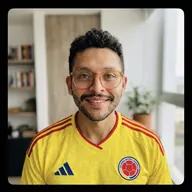
I am Santiago Garnica, a Colombian lawyer and Spanish tutor at Garnica & Co. I teach structured 1:1 Colombian / Latin American Spanish, with short explanations in English (C1) or German (B2) when a rule needs a bridge.
Textbook Spanish is a map — not the city
Textbooks (and many apps) lean on a polished, often Spain-leaning standard: vosotros, formal set phrases, vocabulary that is “correct” but not always natural in Bogotá or Medellín.
A map is useful. Living in the city is different. You still need grammar. You also need the rhythm, the soft consonants, and the everyday words Colombians use at the bakery, in a taxi, or on a work call.
If your materials only show European defaults, your ear trains on a variety you may rarely hear with Latin American colleagues, partners, or travel. That is a design choice in the materials — not proof that you “cannot learn languages.”
Eight concrete contrasts (textbook vs Bogotá everyday)
- Plural “you.” Textbooks drill vosotros. In everyday Colombian Spanish, ustedes covers plural “you” — formal and informal contexts that Spain would split.
- Greetings. Textbook ¿Qué tal? exists, but you will also hear warm, local rhythms and follow-ups that dialogue boxes under-teach. We practice openings you will actually get back.
- Food and drink. Menu words and “what I usually order” differ from European lists. Learning tinto, arepa, or shop phrases early beats memorizing Iberian items you will not order.
- Transport. Asking for directions, buses, apps, and por favor-heavy requests sound different in pace and politeness than a Madrid textbook scene.
- Diminutives and softness. Colombian speech often softens requests (un momentico, careful tone). Learners who sound abrupt are not “rude on purpose” — they copied a flatter textbook register.
- Fillers and discourse. Real turns use pues, entonces, o sea, and pause habits textbooks skip. We add a few high-frequency fillers so conversation feels less like an oral exam.
- Pronunciation targets. Clear vowels; many speakers with softer s/d in places; a pace that rewards careful listening. We correct sounds that block understanding first — not every regional detail on day one.
- Work and email. Colombian professional Spanish is polite and clear. Lawyer-trained lesson planning helps here: goal of the message → phrases → your draft → correction.
None of this means “ignore grammar” or “only slang.” It means pair structure with real LatAm input on purpose.
If you're still deciding whether Latin America or Spain fits your goal, see Latin American vs Spain Spanish.
When the accent (and variety) actually matters
Accent matters when:
- You will travel or live in Colombia or much of Latin America
- Your colleagues and clients speak LatAm Spanish
- Listening practice has only been Spain-centric audio
- You feel stuck: “I understand the app, not real people”
Accent matters less when:
- You only need reading for a Spain-focused exam this month (still learn ustedes; ask for exam forms explicitly)
- You already have a LatAm ear and need grammar repair more than variety switching
Honest framing: one tutor cannot download every dialect into your head. What we can do is give you a stable Colombian base, flag Spain-only forms when they appear in your materials, and train listening with corrections that stick.
Listening drills that transfer (without chaos)
Structured listening beats random YouTube bingeing:
- Same dialogue twice — once for gist, once for one sound or phrase.
- Shadow one sentence — repeat rhythm after the tutor, not 40 new words.
- Personal rewrite — take a textbook line and make it Colombian-natural for your life.
- Weekly clip target — one short authentic snippet (news intro, podcast 60 seconds) with three noted phrases — not a download marathon.
In lessons, listening is tied to speaking. You hear Colombian Spanish. You also produce it with feedback.
Why structure still matters
Random conversation with a native speaker helps — until you repeat the same mistakes for months. At Garnica & Co, the free class and paid lessons follow a simple path: goals → level → weekly focus → homework that fits your life.
You hear Colombian Spanish. You leave with corrections that stick. Stefan wrote that the lesson structure is excellent and that he speaks German and English well. Daniel wrote that a topic is not left until it has been internalized.
Who this is for
- Learners tired of Spain-only materials who will live, travel, or work with Latin Americans
- Beginners who want clarity without chaotic slang dumps
- German and English speakers who need a short explanation in DE or EN, then back to Spanish
- Professionals who want polite, usable Spanish for calls and email — not only tourist dialogues
Price and next step (after you hear the difference)
Book a free 25-minute class on garnica.co (Formspree → Cal.com). Hear Colombian Spanish in a structured first lesson — then decide if the recommended 10-lesson pack ($160) or another pack fits. List price: $20 / 50 min. Also: single $20 · 5 ($85) · 20 ($300).
Policies: reschedule at least 24 hours ahead; a no-show uses 1 credit; packs expire 6 months; no refund on first paid class or a started pack. No WhatsApp wall for booking.
About the author
Santiago Garnica — Colombian lawyer and Spanish tutor. Structured 1:1 Colombian / Latin American Spanish with EN C1 / DE B2 bridges when needed. Direct booking at garnica.co.
FAQ
Is Colombian Spanish “easier” than Spain Spanish?
Many learners find Colombian Spanish clear and approachable, especially vowels and everyday politeness. “Easier” depends on your ear and goals. What is true: if your life is LatAm-facing, training only on Spain defaults creates an avoidable gap.
Will I be understood in Spain if I learn Colombian Spanish?
Yes for most everyday and professional topics. You may need vosotros and some Spain vocabulary for local exams or long stays in Spain. We can add those forms when you need them; the default base remains LatAm.
Do you teach slang?
Lightly and on purpose. High-frequency everyday language yes; chaotic slang dumps no. Beginners get clarity first. Intermediates get situational phrases (travel, work, friends) with boundaries.
How is this different from an app?
Apps map chapters. A tutor maps your week: one focus, spoken production, correction, short homework. The free class shows whether that fit works for you before you buy a pack.
How do I start?
Open garnica.co, complete the short form, get a free 25-minute credit, pick a time on Cal.com. Bring one goal: travel, work, or everyday.
Book the free class
Reserve the free 25-minute class on garnica.co. Hear the difference in a structured lesson — then choose a pack if it fits.
Related: Spanish for German speakers · What the free class looks like · About Santiago
Book a free class
Directly on garnica.co — not a marketplace as the main path.